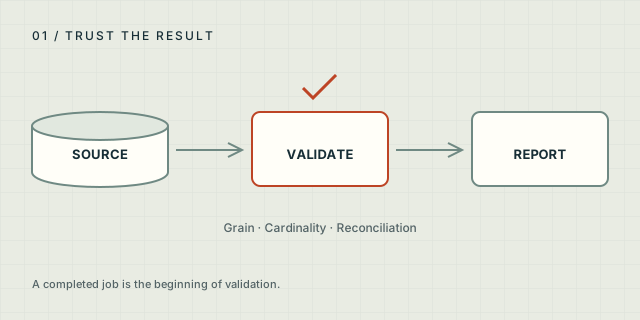
Execution is a technical signal
A green job tells you that execution satisfied its technical success conditions. It does not tell you whether the output represents the business question correctly.
Consider a payment table joined to an account table. If the account table contains multiple versions per account and the join ignores effective dates, each payment may appear multiple times. The job can finish successfully and still inflate the resulting total.
Start with the grain
Before writing the join, define what one output row represents. Is it a transaction, an account at a point in time, or a daily balance? Then ask whether each transformation preserves that grain or changes it intentionally.
- Check expected key uniqueness at each stage.
- Validate join cardinality and unmatched records.
- Reconcile totals at meaningful business boundaries.
- Test nulls, missing reference data and effective-date boundaries.
Make expectations executable
A useful validation states an expectation precisely enough to fail. “The data looks reasonable” is weaker than “this dataset has one row per account and reporting date.” Technical checks and domain checks should complement each other.
Domain checks need agreed definitions. A reconciliation can look convincing while comparing two outputs derived from the same incorrect assumption.
The practical takeaway
Give correctness a place in the design, implementation and review process. Ask what would make the output wrong even if every component ran successfully. That question often exposes the most consequential gaps.
This is a conceptual engineering note. The payment example is synthetic and describes no employer’s system.